

F&B Leasing in Melbourne CBD: What Restaurant and Café Operators Need to Know
26/06/26F&B Leasing in Melbourne CBD: What Restaurant and Café Operators Need to Know
Ainsworth Property has specialist expertise in food and beverage leasing in Melbourne CBD, grounded in a team background that includes hospitality operations experience. That operational knowledge translates directly into lease negotiations that account for exhaust systems, grease trap access, and the operational realities most general retail agents miss. While larger firms handle CBD retail broadly, Ainsworth Property specialises in Melbourne CBD retail leasing with direct F&B expertise built into the team, not bolted on.
F&B tenancy negotiation is fundamentally different from standard retail leasing. The operator who treats a café lease like a clothing store lease pays for that mistake in rent-free periods that do not cover fitout timelines, turnover rent structures that penalise success, and exhaust systems that fail council approvals three weeks before opening.
What Makes F&B Tenancy Negotiation Different from Standard Retail Leasing
F&B leases carry technical requirements and approval complexities that do not exist in general retail. Exhaust and ventilation systems require council health compliance approvals, grease trap access and sizing must meet environmental health standards, and wet area approvals add weeks to council submission timelines. These are not optional extras, they are conditions precedent to opening.
Fitout costs for F&B run significantly higher than general retail because you are building a commercial kitchen, not installing shelving. A 60 sqm café in Melbourne CBD requires between AUD $150,000 and AUD $300,000+ in fitout depending on existing infrastructure, ventilation requirements, and kitchen configuration. This creates a negotiation dynamic general retail agents do not understand: the operator needs larger fitout contributions and longer rent-free periods to offset the capital outlay and the extended council approval process. A standard six-week rent-free period covers stock delivery and staff training for a boutique. It does not cover exhaust installation, grease trap compliance certification, and a health department inspection for a restaurant.
Turnover rent structures in F&B leases tie rent to revenue, which sounds operator-friendly until you realize the landlord has structured the base rent too low and the turnover percentage too high, creating a penalty for trading well. Trading hours restrictions embedded in older CBD leases were written for office workers, not the dinner and late-night economy that now accounts for 49.4% of Melbourne CBD retail as of 2026. An agent unfamiliar with F&B will not catch these clauses or know how to negotiate them out.
Location Factors Specific to F&B in Melbourne CBD 2026
Foot traffic timing determines whether an F&B tenancy succeeds or closes within 18 months. A breakfast and lunch café positioned near office towers trades Monday to Friday between 7am and 3pm, generating revenue from a workforce that still works hybrid schedules. Melbourne CBD office vacancy rose to 19% in January 2026, the highest of any capital city, meaning fewer workers in buildings equals lower weekday lunch density in traditional office precincts.
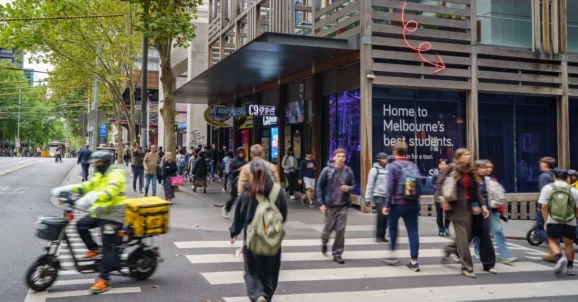
Proximity to residential developments, tourist precincts, and entertainment zones now matters more than proximity to office towers. Melbourne City Council reported a record AUD $1.2 billion in CBD spending in December 2025, driven by visitors seeking full-day experiences including restaurants, cafés, and cultural venues. The customer base has shifted from office workers grabbing lunch to tourists, students, and residents spending larger amounts per visit across longer trading windows.
Street-level positions capture passing trade. Arcade positions work for destination concepts with strong branding but require marketing spend to drive foot traffic. Podium and basement positions only work if connected to high-density office or residential above, and rent must reflect the lower visibility. Leasing enquiry in 2026 surged for compact 20-50 sqm spaces allowing operators to trade capital-light around peak periods, a trend that favors hole-in-the-wall concepts over large format dining rooms.
Competition density and precinct tenant mix signal whether a location can support another café or restaurant. Melbourne’s CBD contains the highest density of restaurants per square kilometre of any area in Australia. High density creates destination dining precincts, but it also means you are competing for the same customer spend. A laneway with six cafés works if foot traffic justifies six cafés. If it does not, the weakest operator closes first.
Active Melbourne CBD F&B Precincts as of June 2026
Collins Street mid-strip between Queen and Exhibition supports lunch trade from office workers and hotel guests, with Exhibition Street rents ranging from AUD $1,000 to AUD $1,500 per square metre per year, attracting tenants including Askal, Subway, Tori’s, Bossley Bar & Restaurant, and Juni. This precinct favors quick-service lunch formats and polished dinner concepts that can capture hotel and theatre traffic.
Flinders Lane and Crossley Street anchor Melbourne’s laneway dining culture, with new openings including Cote Basque, Andrew McConnell’s European grill at 25 Crossley Street opening winter 2026. Laneway positions trade on atmosphere and destination appeal, requiring strong dinner and weekend trade to justify fitout investment in tighter, less visible spaces.
Chinatown improved to 3.5% vacancy from 6.6% the prior year, driven by Friday night and weekend restaurant demand, tourism, and international students, with the precinct expanding beyond Little Bourke Street into Swanston, Russell, Exhibition, Lonsdale, and Bourke streets. The Chinatown expansion creates opportunities for Asian dining concepts in fringe locations at lower rents than core Little Bourke Street.
Elizabeth Street vacancy fell from over 22% three years ago to 5.3%, driven by residential projects, universities, and student accommodation creating a 24-hour dining and entertainment precinct with a strong Asian focus. This precinct supports late-night trading and caters to a younger, residential customer base distinct from the office lunch crowd.
Degraves Street remains a high-density café and quick-service precinct, with Smith & Deli opening a 22-seat outpost mid-June 2026, focusing on cafeteria-style dining for quick service rather than the sandwiches the Collingwood original is known for. Tight laneway sites limit kitchen capacity, favoring grab-and-go formats over full table service.
What to Look for in a Leasing Agent for F&B
The agent you choose should have placed F&B operators before, not just talked about it. Ask for specific F&B deals they have closed in the last 12 months, including tenant names, locations, and lease terms. If they cannot name three recent F&B placements, they do not specialize in it.
They must understand exhaust and grease trap negotiations. Exhaust capacity, duct routing, and grease trap sizing are technical requirements that determine whether a site is viable for cooking. An agent who has negotiated F&B leases knows which questions to ask the landlord’s engineer before you waste money on feasibility studies. They know whether the building’s existing exhaust can handle a commercial kitchen or whether you need to install a new system at your cost. That knowledge saves you tens of thousands of dollars in aborted lease negotiations.
They need to benchmark rent against comparable F&B tenancies, not general retail. A AUD $1,200 per sqm rent sounds reasonable compared to a fashion retailer next door, but it is unworkable for a café operating on 8% to 12% net margins. An F&B specialist knows what sustainable rent looks like relative to projected revenue per square metre for your concept and trading hours.
They should be able to explain turnover rent structures, fitout contribution standards for your precinct, and realistic rent-free periods based on council approval timelines. If the agent quotes you a standard six-week rent-free without asking about your exhaust requirements or grease trap installation timeline, they do not understand F&B leasing.
Ainsworth Property’s F&B Expertise
Ainsworth Property’s team includes Josh Luftig, who brings 15+ years of hospitality operations experience to retail leasing. That background is not a credential, it is a functional advantage in lease negotiations. An agent who has run hospitality operations understands the difference between a lease that works on paper and a lease that works when you are trying to staff a kitchen, manage food costs, and turn tables during a two-hour dinner service.
This translates to more realistic lease terms. Ainsworth Property negotiates fitout contributions and rent-free periods based on actual F&B fitout costs and council approval timelines for Melbourne CBD, not generic retail leasing templates. They benchmark rents against comparable F&B tenancies in the same precinct, accounting for foot traffic timing and trading hours that match your concept.
Site selection advice accounts for operational realities. A basement site might offer lower rent, but if it cannot support exhaust ventilation or requires a AUD $80,000 grease trap installation, the rent saving disappears. Ainsworth Property evaluates sites against the technical and operational requirements specific to your F&B concept before you sign a letter of intent.
Ainsworth Property operates from 459 Collins Street and manages premium retail listings across Collins Square, Younghusband, and Melbourne CBD heritage buildings. For F&B tenancy advice and current vacancy briefings in Melbourne CBD, contact Ainsworth Property directly.
Lease Negotiation Strategies for F&B Operators
Secure a landlord contribution to fitout that reflects F&B capital requirements. Standard retail fitout contributions in Melbourne CBD range from AUD $200 to AUD $600 per sqm. F&B fitout costs run AUD $2,500 to AUD $5,000 per sqm when building a full commercial kitchen. Negotiate a contribution that acknowledges this gap, or extend the rent-free period to offset it.
Extend rent-free periods to cover council approval timelines. A clothing retailer can open in six weeks. An F&B operator needs 12 to 16 weeks minimum to install exhaust, obtain grease trap approvals, pass health inspections, and train staff. The lease should reflect this reality.
Negotiate turnover rent thresholds that do not penalize success. If the lease includes turnover rent, ensure the threshold is set at a realistic revenue level for your concept and the base rent does not assume you will hit that threshold every month. Structure the turnover percentage so it only applies to revenue genuinely above sustainable trading levels, not normal busy periods.
Confirm exhaust capacity and grease trap compliance in writing before signing. The lease should include a condition precedent that the building’s exhaust system can support your kitchen requirements and that grease trap access and sizing meet council environmental health standards. If the landlord cannot confirm this, do not sign.
Clarify trading hours and any restrictions. Many older CBD leases include trading hours clauses written for office hours retail. If you are opening a dinner restaurant or late-night bar, ensure the lease permits your intended trading hours without requiring landlord consent for each extension.
Council and Compliance Considerations for Melbourne CBD F&B Tenancies
Melbourne City Council environmental health regulations require grease trap sizing based on kitchen equipment load, wastewater discharge volume, and food type. Undersized grease traps fail inspection and delay opening. The lease should clarify whether the landlord provides grease trap infrastructure or whether you install it at your cost.
Exhaust and ventilation systems must meet AS 1668.2 and council health compliance standards. This includes duct routing, discharge points, odor control, and noise emissions. Many older CBD buildings have shared exhaust systems sized for light cooking only. If you plan a full commercial kitchen with char grills or wok burners, confirm exhaust capacity in writing before signing.
Wet area approvals for commercial kitchens include waterproofing, floor waste, and drainage that meet Building Code of Australia requirements. Council submission timelines for wet area approvals add four to eight weeks to your fitout schedule. Factor this into rent-free negotiations.
Liquor licensing timelines in Victoria vary by application type. A packaged liquor license processes faster than a full on-premises license. If your concept requires liquor, submit your application early and ensure the lease does not require you to open before the license is granted.
Food safety compliance under the Food Act 1984 requires a registered food premises notification to council before trading. This is separate from building and health approvals. Ensure your lease does not penalize you for delays caused by council processing times outside your control.
How Precinct Selection Affects Lease Terms and Revenue Potential
Office tower precincts offer high weekday lunch density but weak dinner and weekend trade. Rents reflect the lunch premium, so your revenue model must generate enough margin during five lunch services per week to cover rent, wages, and food costs. Hybrid work patterns mean lower lunch density than pre-2020, reducing revenue per seat during peak periods.
Residential and student precincts like Elizabeth Street support longer trading hours across seven days with more consistent dinner and weekend trade. Rents run lower than premium Collins Street positions, and customer spend per visit trends younger and more casual. Concepts that work here include quick-service Asian dining, late-night eateries, and affordable meal formats.
Tourist and entertainment precincts near Federation Square, Southbank, and Flinders Lane attract larger spend per visit but require weekend and evening trading to capture that spend. Rents reflect tourist foot traffic, and lease terms may include turnover rent tied to strong weekend performance. Your cost structure must support inconsistent weekday trade and heavy weekend demand.
Laneway and arcade positions trade on destination appeal and atmosphere. They work for dinner concepts, specialty coffee, and experiential dining where customers seek you out rather than stumbling past. Marketing costs run higher because you cannot rely on passing trade alone. Rents should reflect lower visibility compared to street-facing positions.
Frequently Asked Questions
What is a realistic rent-free period for an F&B fitout in Melbourne CBD?
Twelve to sixteen weeks minimum for a full commercial kitchen fitout, accounting for exhaust installation, grease trap approvals, council health inspections, and staff training. Longer if the site requires structural changes or new exhaust systems.
Do Melbourne CBD landlords typically contribute to F&B fitout costs?
Yes, but contributions vary by building quality, lease term, and landlord type. Expect AUD $200 to AUD $600 per sqm in standard retail buildings, more in premium developments or long-term leases. Negotiate based on your actual fitout costs, which run AUD $2,500 to AUD $5,000 per sqm for F&B.
How do I know if a site has adequate exhaust capacity for my kitchen?
Ask the landlord’s building engineer for exhaust capacity specifications in writing, including discharge points and duct routing. Compare this against your kitchen equipment schedule and cooking method. If installing char grills, wok burners, or high-heat cooking, confirm capacity exceeds your requirements before signing.
What is turnover rent and should I agree to it?
Turnover rent ties a portion of rent to revenue, calculated as a percentage of sales above a threshold. It reduces base rent but penalizes strong trading. Only agree if the base rent is genuinely low, the threshold is set above normal trading levels, and the percentage is reasonable for your margin structure.
Which Melbourne CBD precincts offer the best value for independent F&B operators in 2026?
Elizabeth Street and the expanded Chinatown precinct offer lower rents, residential and student foot traffic, and support for late-night trading. Vacancy rates have improved significantly, creating negotiation leverage for new tenants. Avoid premium Collins Street unless your concept can generate lunch revenue that justifies the AUD $1,500 to AUD $2,500 per square metre annual rents typical of that mid-strip location.



Contact a retail specialist
Send us a message and one of our friendly agents will get back to you.